September 9, 2026 · 6 min read
AI writing assistant that sounds like you: a buyer's framework for 2026
Every AI writing assistant claims to sound like you. Here's the real difference between prompt-based, instruction-based, and sample-based tools, and how to pick the right one.
Which category of tool actually fits your job
"AI writing assistant that sounds like you" gets used to describe four different products, and most buying guides blur them together. Before comparing tools, separate the job you have from the job the tool was built for.
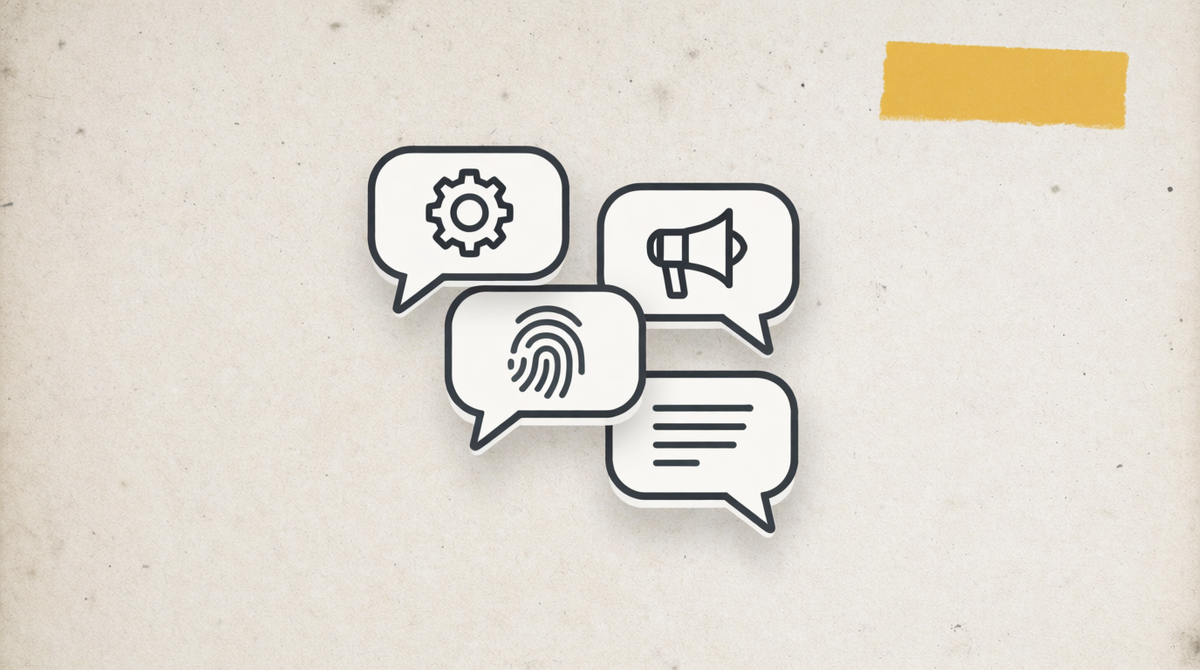
A generic assistant like ChatGPT or Claude writes whatever register the prompt implies. A custom-instructions preset stores a standing block of text the model reads before every reply. A brand voice platform governs terminology and tone across a team, not a person. A voice profile is built from real writing samples and travels with you across tools.
- One-off email or single document: generic assistant with a clear prompt is enough.
- Recurring personal writing (newsletter, blog, DMs): custom instructions or a voice profile, since you want the setup to persist without re-explaining yourself.
- Team content at scale: a brand voice system, because the goal is consistency across many writers, not one person's cadence.
Match the category to the job, not the marketing copy on the landing page.
Why pasting your writing into a chat thread stops working
The most common piece of advice online is: paste a stack of your old writing into ChatGPT, ask it to analyze your tone, then keep using that same thread. It works for a session or two, then quietly degrades.
The reason is mechanical, not mysterious. Every large language model operates within a context window, a fixed budget of tokens it can hold in working memory at once. As a conversation grows past that budget, the model has to drop earlier content to make room for new messages. Your carefully built voice profile is exactly the kind of content that gets pushed out first, because it was established early in the thread.
The mechanics behind this failure mode are covered in more detail in our piece on how to train AI to write in your voice, including why re-pasting the same instructions every few messages is a workaround, not a fix.
So the practical question isn't whether an assistant can sound like you once. It's whether the setup survives a new chat, a new week, or a new project without you starting over.
What changed with custom instructions in 2026
OpenAI expanded ChatGPT's custom instructions field from roughly 1,500 characters to more than 5,000 in July 2026, according to reporting from MindStudio. That's a real, measurable change: a stable slot for background, preferences, and rules that gets applied automatically to every new conversation, instead of living and dying inside one thread.
This partially fixes the context-window problem above, because custom instructions sit outside the conversation itself. But two limits remain worth knowing before you rebuild your setup around it:
- Custom instructions are static. They don't update from new writing the way a memory system or a purpose-built voice profile can. You have to manually revise the block yourself.
- They are provider-specific. A 5,000-character block written for ChatGPT's Personalization settings does not travel to Claude, Gemini, or any other model without being copied over by hand.
If your writing voice only needs to exist inside one product, the expanded limit is a meaningful upgrade. If you write across multiple tools, or you want your voice setup to survive a provider switch, portability becomes the deciding factor.
The four-category comparison in practice
Here is how the four categories actually differ once you get past the marketing copy, based on how each is built and where it breaks:
- Generic assistants (ChatGPT, Claude, Gemini): no persistent voice by default. You supply tone through the prompt every time. Best for tasks where output quality matters more than personal identity.
- Custom instructions: a fixed block you write once, applied automatically. Improved a lot with the 2026 character-limit expansion, but static and locked to one provider.
- Brand voice tools: built for organizational governance, meaning shared terminology, approved phrasing, and tone rules enforced across a team of writers. Not designed to capture one person's specific rhythm or vocabulary.
- Voice profiles: extracted from real writing samples rather than written instructions. The idea is that the system learns your actual patterns, including sentence length, transitions, and where you hedge versus where you're direct, instead of you describing them.
The category that gets skipped in most roundups is the difference between a system that reads a description of your voice and one that's trained on your actual sentences. A description is an approximation. A profile built from samples captures things you wouldn't think to write down, like where you tend to break a long sentence in two, or how often you actually use contractions versus how you think you write.
A decision framework: which one do you actually need
Instead of ranking tools, answer three questions about your own situation.
- How often do you need this voice to show up? Daily and recurring points toward a persistent setup (custom instructions or a voice profile). Occasional points toward a good prompt on a generic assistant.
- Do you write across more than one AI tool? If yes, a provider-locked custom-instructions block means duplicating your setup manually every time you add a tool. A portable profile avoids that duplication.
- Is this about one person's voice or a team's consistency? One person's voice is a voice-profile problem. A team's consistency is a brand-voice-tool problem, and conflating the two is why some brand voice rollouts feel flat and impersonal.
Most people land in more than one category at once. A solo founder might want a personal voice profile for their newsletter and a lightweight style guide for occasional freelance help. That's normal. The framework is meant to stop you from buying a team tool to solve a one-person problem, or expecting a single ChatGPT thread to hold a voice indefinitely.
What imperfectly does differently
imperfectly is built as a voice profile in the framework above, not a generic assistant or a brand voice governance layer. It analyzes writing samples you provide, builds a portable profile of your patterns, and applies it to editing or drafting without needing you to re-paste instructions into every new session.
If your problem is closer to the fine-tuning end of the spectrum, our companion piece on AI trained on your writing to sound like you walks through what training a model on your writing actually costs and risks, and why a profile-based approach avoids most of that risk.
For a narrower look at just the ChatGPT-specific workflow, see how to make ChatGPT sound like you, which walks through prompt structure inside that one interface.
The core difference is what happens after the first session. A profile built from your samples doesn't rely on conversation memory, and it doesn't require you to rewrite a 5,000-character instructions block by hand every time your writing evolves.
Common mistakes when picking an AI writing assistant for your voice
- Assuming any tool that says "sounds like you" works the same way. Read past the tagline to find out whether it's prompt-based, instruction-based, or sample-based.
- Rebuilding your voice setup from scratch in every new AI tool instead of choosing one portable approach.
- Treating a single long ChatGPT thread as permanent storage for your voice, when the context window will eventually push it out.
- Using a brand voice tool built for team governance to solve a personal, one-writer problem. The fit is wrong even if the tool is well built.
- Skipping the character-limit conversation entirely and assuming custom instructions can hold everything you'd want a full voice profile to capture.
Frequently asked questions
What is the difference between custom instructions and a voice profile?
Custom instructions are a fixed block of text you write yourself inside one product's settings, applied automatically to every new chat. A voice profile is built from real writing samples and captures patterns you might not think to describe, and it's designed to be portable across tools rather than locked to one provider.
Why does ChatGPT stop sounding like me partway through a long conversation?
Every model works within a fixed context window. As a conversation grows, earlier content gets pushed out to make room for new messages, and voice instructions established early in the thread are often the first to go.
Does the 2026 custom instructions update fix the voice-consistency problem?
Partially. The expanded 5,000-character limit means more persistent context per conversation, but it's still static (you edit it manually) and provider-specific (it doesn't transfer to a different AI tool).
Should I use a brand voice tool for my personal writing?
Usually not. Brand voice tools are built for team-level consistency across multiple writers and don't capture one person's specific rhythm or vocabulary the way a sample-based voice profile does.
How is imperfectly different from asking ChatGPT to write like me?
imperfectly builds a portable profile from your actual writing samples instead of relying on a single chat thread's memory or a manually written instructions block, so the setup survives new sessions and doesn't need to be rebuilt from scratch.