September 23, 2026 · 9 min read
How would your writing sound without transition words?
Delete the connectors and your draft usually reads better. Here is what the connective data says about machine writing, and how to run the pass on your own work.
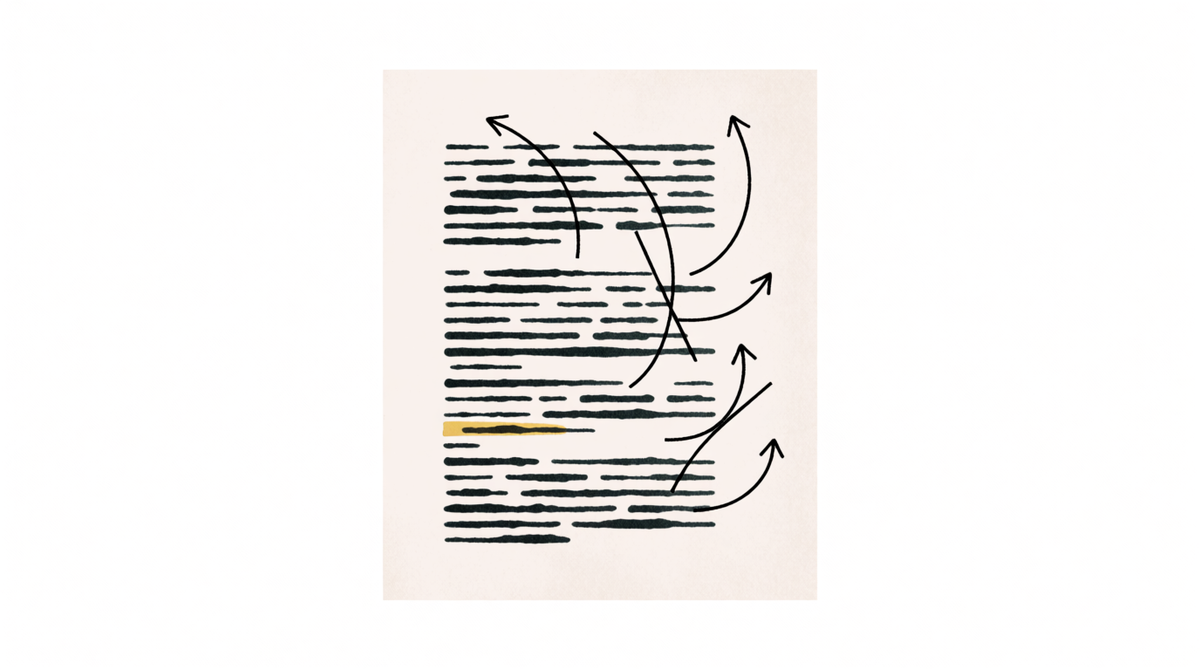
What happens when you delete every transition word?
Your writing sounds sharper after a single pass. Delete the connector at the start of each sentence and the sentences still stand on their own; what goes away is the hum of someone labelling a structure instead of saying something. That's the whole result, and it takes about ten minutes to confirm on a draft of your own.
Most writers assume those words are load-bearing. They usually aren't. A connector is a label for a relationship, and in a well-ordered paragraph the reader has already worked the relationship out from the sequence of the sentences. The label arrives after the work is done.
Here's the test. Take 400 words you wrote and copy them somewhere you don't mind ruining. Delete every connector at the start of a sentence. Then read both versions out loud, which is the only part of this you can't fake. The deleted version reads faster in about four cases out of five.
The fifth case is where the real work is, and it's worth slowing down for. More on that below.
Why the deleted version reads better
Removing a connector doesn't change your logic. It changes who appears to be doing the thinking. A sentence that opens with a connector announces that a relationship is about to be supplied. A sentence that opens with its subject just supplies it.
There's a rhythm cost too, and it's the part most editing advice skips. Connectors run two to four syllables, they land in the same position, and a comma follows. A paragraph built that way has a metronome, and readers hear it even when they can't name it. Our breakdown of the patterns readers notice first covers the rest of that list.
The last reason is the uncomfortable one. Connectors let you skip the work of connecting. If two ideas don't actually follow from each other, a connector papers over the gap well enough to carry you into the next paragraph. Delete it and the gap is visible. That's not a flaw in the test. That's the test doing its job.
It's also why blanket deletion advice is right more often than it should be. Connectors aren't the problem. The ones that survive a deletion attempt are the ones doing real work, and the ratio between the two is usually humbling.
Which connectors make you sound like a machine?
Not the ones you'd guess. Causal connectors are the most human thing in the toolbox and structural ones are the most replaceable. A study published on Faculty Focus on February 7, 2024 measured exactly this.
Miriam Bowers-Abbott and Wyatt Abbott compared 34,170 words of student writing with 9,501 words generated by ChatGPT and Bing in January 2024, counting each connective per 1,000 words (Faculty Focus, February 7, 2024). The models used "however" three times as often as the students, 3.47 against 1.08 per 1,000 words. Students used "because" fifteen times as often, 3.78 against 0.21, used "so" ten times as often, and used "if" five times as often. Two words, "since" and "too", never appeared in the machine text at all.
Read that again, because it's the whole argument in one table. The model didn't use more connectors. It used a narrower set, and it reached for the ones that label structure rather than the ones that carry a reason.
Elizabeth Steere found the same thing from the other direction. In "Anatomy of an AI Essay", published in Inside Higher Ed on July 2, 2024, she had ChatGPT 3.5 and the free version of Grammarly write more than 50 analytical essays on early American literature. The paragraphs kept opening with formulaic markers. One essay opened five consecutive paragraphs with, in order, a first-item marker, a contrast marker, an addition marker, an alternative marker, and a closing marker. She reports that AI essays were far more likely than human ones to begin paragraphs with the three academic connectors she tracked most closely.
Two claims get mixed together here, so it's worth pulling them apart. The prose isn't bad. A large-scale comparison published in Scientific Reports in 2023 found that human reviewers rated ChatGPT-generated essays higher on quality than human-written ones. Quality isn't the issue. Sameness is: a fixed set of connectors, in a fixed position, at a regular interval. That's a signature, and readers pick up signatures.
The three families of connectors, and what each one costs you
Sort your connectors into three groups and the decision gets simple.
Causal connectors carry a reason: because, so, since, as a result. Keep them. They're doing the reader's work for them, and the data above says human writers lean on this group far more than models do.
Contrast connectors mark a turn: but, though, on the other hand, and the one the model over-uses. "But" is cheap and human and sits happily at the start of a sentence. The formal alternative is the single most reliable way to make a paragraph sound like a memo. If you've used it more than once in 500 words, you're probably using it to avoid writing a better first sentence.
Structural connectors label position: additionally, in addition, also, first, second, finally. These are the easiest to delete, because the reader already knows they're reading a list from the fact that it's a list. Keep the first one if the order genuinely isn't obvious.
Closing markers announce that a section is finished. Delete them and let the section end. A paragraph that stops when it's done needs no announcement.
When you actually need a connector
Four cases where deleting the connector creates a problem, and one where it doesn't.
The first is a long-range reference. If the sentence you're connecting back to sits three paragraphs up, the reader is holding too much to infer the relationship. Name it.
The second is concession. When you're granting the other side something before you take it back, the turn has to be signposted, or it reads as agreement.
The third is a genuine misread risk. If a reader could reasonably assume cause and you mean sequence, spell it out. Ambiguity costs more than a short connector does.
The fourth is a change of subject inside a single paragraph. When you move from one actor to another, a brief marker is cheaper than splitting the paragraph.
The case where you don't need one is every other time. If two sentences can be read in order without guessing, the connector is decoration. Decoration is fine in a first draft and expensive in a published one.
The deletion pass, step by step
Five steps, about ten minutes per thousand words.
One: mark every connector at the start of a sentence. Highlight them and keep moving. Don't fix anything yet.
Two: delete them all in one pass. No negotiating, no keeping one because it feels important. You want an honest picture before you start making exceptions.
Three: read it out loud and mark the sentences where you lose the thread. Those are the real candidates, and there are usually fewer of them than you expected.
Four: repair those sentences by rewriting the opening, not by putting the connector back. Nine times out of ten the fix is to start with the thing you were being vague about.
Five: put back the two or three connectors that survived step four, and check whether any of them should be a shorter word. A formal sentence-opener is often just "But". "Therefore" is usually "So". "In addition" is usually nothing. The whole craft of editing a draft without flattening your voice lives in passes like this one.
The pass works because it's subtractive first. Advice that asks you to judge each word in place runs into the fact that you'll defend your own habits. Deleting everything removes the choice, and what you re-add is a decision you can actually see.
Before and after: one paragraph, three versions
Here's a paragraph as a model usually writes it. It's shortened, but the pattern is faithful.
"Remote teams need clear documentation. Firstly, it reduces the number of repeated questions. Additionally, it gives new hires a faster path to their first contribution. Additionally, written documentation forces decisions to be made explicit."
Now delete the openers. "Remote teams need clear documentation. It reduces the number of repeated questions. It gives new hires a faster path to their first contribution. Written documentation forces decisions to be made explicit."
Faster to read, and the third sentence is where the argument actually is. So the next pass moves it. "Remote teams need clear documentation, mostly because writing things down forces decisions to be made explicit. The side effects are fewer repeated questions and a faster first contribution for new hires."
That version is shorter than the original, it has one connector instead of three, and the connector is causal, which tells you which claim matters most. That's the whole pattern: fewer connectors, better ones, and a sentence order that shows your ranking.
Does removing transitions change what a detector sees?
A little, and not in the way most people hope.
Detector scores lean on properties like rhythm uniformity and connective density, which is exactly what this pass disturbs. Flat, evenly connected prose is the shape the scores were built to catch. But deleting connectors to move a number is a losing game, because you can do all of the above and still trip a detector on the features this pass never touches.
The honest framing is that this is a writing exercise that happens to improve a reading, not a loophole. If a score is what you're chasing, start with what a detector score actually means, and remember that the tools disagree with each other by wide margins on the same text.
And a note for writers working in a second language. The instinct to reach for the most formal connector available is usually taught rather than chosen, and it's the exact instinct that makes a draft read as machine-written. Connectors are one of the few places where writing more like you talk is also writing more accurately. Our guide to getting translated rhythm out of your sentences walks through the rest of it.
The short version
Your writing sounds better without most connectors, not worse. Causal connectors are the ones worth keeping, structural labels are the ones to cut, and a model is far more likely than you're to reach for the second group.
If you want the fuller catalogue of habits that make text read as machine-written, our piece on the patterns that give AI writing away is the companion to this one. For the register problem specifically, the guide to sounding less formal without sounding sloppy covers contractions, hedges and vocabulary.
One thing before you close the tab. The deletion pass is also the fastest way to find the parts of a draft you don't believe. A connector is the cheapest thing to hide a gap behind, and gaps are what you want to see while you can still fix them.
Frequently asked questions
Do transition words make your writing sound like AI?
Some do, and it isn't the ones people expect. A February 2024 study on Faculty Focus found models used the formal contrast connector three times as often as student writers, while students used causal connectors like because and so ten to fifteen times as often. The tell isn't the number of connectors. It's a narrow set used on a fixed schedule.
Can you delete every transition word and still be understood?
Usually yes, and the draft reads faster afterwards. Keep four exceptions in mind: a reference that reaches back several paragraphs, a concession you're about to take back, a place where sequence could be misread as cause, and a shift of subject inside one paragraph. Everything else is a label the reader has already inferred.
Which connectors are worth keeping?
The causal group: because, so, since, as a result. They carry a reason and they're the words human writers reach for far more than models do. Structural labels are the easiest to cut, because the reader can see that a list is a list without being told.
Will removing transitions lower an AI detector score?
It can move the reading, because detectors lean on rhythm uniformity and connective density. It isn't reliable. Detectors disagree with each other by wide margins on the same text, and flat prose can still fail on features a deletion pass never touches. Treat it as a writing exercise that happens to change a reading.
Is this different for non-native writers?
The pattern is stronger, because formal connectors are usually taught rather than chosen, and a taught connector is exactly what a model reaches for too. Writing more like you talk is the fix, and it usually makes the writing more accurate as well as more human.